Designing Your 2026 Stress Processing Journal in Canva
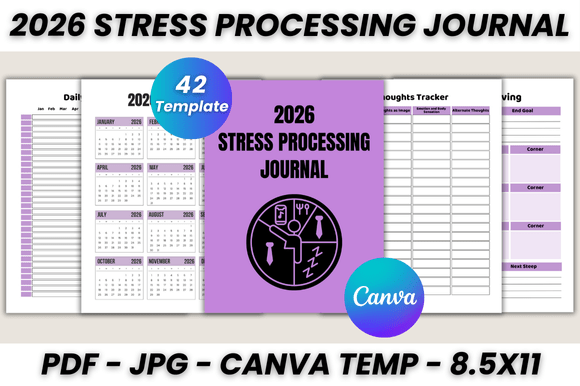
As we approach the new year, the conversation around mental health tools has shifted from generic self-help to highly personalized, visually engaging design assets. For designers, entrepreneurs, and content creators, the ability to curate a functional yet aesthetically pleasing planner is a critical part of a productive workflow. The 2026 Stress Processing Journal Canva represents a significant leap in editorial design, offering a comprehensive 42-page template system that blends modern typography with practical psychological frameworks. It moves beyond simple scheduling, providing a structured environment to deconstruct anxiety through design.
The Anatomy of a Functional Design System
Unlike standard planners that rely solely on linear scheduling, this template utilizes a sans serif font foundation that ensures maximum readability across both digital screens and print media. The visual hierarchy is established through clean lines and ample white space, preventing the user from feeling overwhelmed by the content. This isn't just a collection of pages; it is a cohesive brand identity for your personal well-being. The structure includes standard organizational tools like the 2026 Calendar and Monthly Planner, but the true value lies in the specialized modules.
The journal incorporates specific "Stress Walkthrough" pages designed to guide the user through cognitive reframing. For instance, the pages dedicated to analyzing what elements of an event are controllable versus uncontrollable rely on clear visual cues to separate data points. This application of modern typography helps in creating distinct zones for thought processing, making the act of journaling a tactile, visual experience rather than a purely text-based one.
Visual Psychology and Brand Consistency
For the creative professional, consistency is the hallmark of quality. The 2026 Stress Processing Journal Canva leverages a creative font palette that balances professionalism with approachability. When you open the editable files, you will notice that the typeface choices are deliberate. The headings likely utilize a bold, confident display font to grab attention, while the body copy remains a legible sans serif font to reduce eye strain during long writing sessions. This interplay of font weights is essential for maintaining user engagement.
Consider the "Worry Exploration" and "Stress Source" sections. In editorial design, the goal is to make information digestible. By using subtle typographic variations—perhaps a shift in weight or a slight change in tracking—the template signals to the user that they are entering a different mode of thinking. This is a technique often used in high-end packaging design and web design to guide the consumer’s eye. In this context, it guides the user’s mind toward introspection and problem-solving.
Practical Application for Creators and Entrepreneurs
If you are a small business owner or a content creator, your time is your most valuable asset. The inclusion of a Daily Habit Tracker and Self-Care Calendar within the 2026 Stress Processing Journal Canva allows for a holistic view of productivity and wellness. From a design perspective, these pages serve as excellent examples of grid systems in action. They demonstrate how to organize complex data—like daily routines and emotional check-ins—into a clean, scannable layout.
Furthermore, the "A Letter To My Self" and "Monthly Reflection" pages offer a unique opportunity for personal branding. Even in a private journal, the aesthetic of the page influences how we perceive our own thoughts. A well-designed page can make a mundane task feel significant. For those who use Canva for social media graphics, these templates also serve as a masterclass in layout composition. You can observe how text blocks interact with negative space, a skill that translates directly to creating better Instagram stories or Pinterest pins.
Customization and Commercial Flexibility
The true power of the 2026 Stress Processing Journal Canva lies in its adaptability. Because it is built on the Canva platform, it requires no specialized software like Adobe InDesign or Illustrator. This democratization of premium font usage and layout design means that anyone with a free Canva account can modify the template to fit their specific needs.
You might choose to adjust the color palette to match your existing brand identity or swap out the handwritten font elements for a more corporate serif font if you are adapting this for a team environment. The "Editable Files" feature ensures that you are not locked into a static design. Whether you are a crafter looking to print this for a physical product or a digital nomad keeping it on your tablet, the flexibility is built-in.
Ultimately, this journal is more than just a planner; it is a tool for emotional regulation through design. It proves that the visual environment in which we process our thoughts matters just as much as the thoughts themselves. By integrating high-quality design assets with practical mental health exercises, the 2026 Stress Processing Journal Canva sets a new standard for functional, beautiful planning.